Legislative Basis for the KDE Approved List of K-12 Reading Intervention Resources
House Bill (HB) 253 (2026) prohibits school districts from using any curriculum, reading intervention, or instructional program that employs the three-cueing system to teach students to read. Per Section 1(3), beginning with the 2029–2030 school year, public school districts may not use any curriculum, reading intervention or instructional program that utilizes the three-cueing approach.
HB 253 (2026) further requires the Kentucky Department of Education (KDE) to establish an approved list of reading interventions that are scientifically researched, evidence-based, and do not include instructional strategies aligned to the three-cueing system.
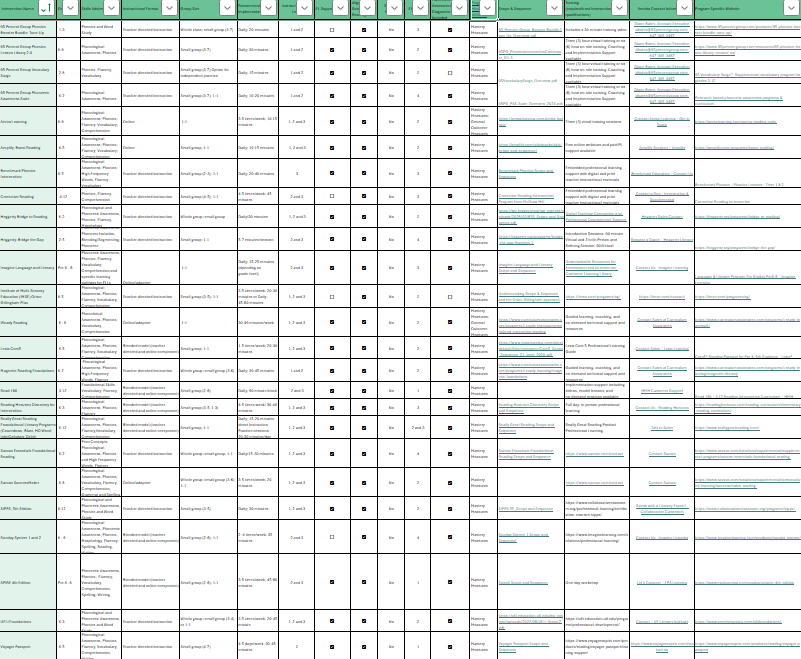
To support this requirement, KDE has developed a spreadsheet of approved K-12 structured literacy-based reading intervention resources. This tool is intended to assist district leaders in evaluating and selecting high-quality interventions aligned to their local context.
The approved intervention resources are aligned to the Kentucky Academic Standards (KAS) for Reading and Writing and are designed to complement districts’ adopted core comprehensive reading high-quality instructional resources (HQIRs). This alignment is essential for meeting the needs of students who require accelerated learning to reach proficiency in reading, including phonemic awareness, phonics, fluency, vocabulary and comprehension.
The KDE recommends districts first consider Tier 2 and/or Tier 3 interventions that are embedded within or aligned to the skills and content of their approved Tier 1 HQIRs. This approach promotes coherence across instruction and intervention, ensuring students receive consistent, coordinated support that extends and builds on grade-level learning throughout the instructional day.
The Importance of Coherence Between Tier 1 Instruction and Intervention
Coherence between Tier I instruction and intervention is critical to improving reading outcomes. When intervention aligns with the same scope and sequence, instructional routines, and content as the high-quality instruction resource (HQIR) used in Tier 1, students experience consistent, reinforcing instruction rather than fragmented learning.
Research on effective literacy systems demonstrates that students make faster progress when intervention targets the same foundational skills, language structures, and knowledge-building emphasized in Tier I. In contrast, misalignment introduces competing approaches, inconsistent terminology, and differing expectations–often leading to confusion, reduced transfer of skills, and slower progress. Aligned systems, however, enable educators to (1) use common data, (2) reinforce prior learning, and (3) build mastery through purposeful previewing, repetition, and extension of Tier 1 content. As reflected in state guidance and national research, instructional coherence is a key principle of a mutli-tiered system of support (MTSS), and intervention should align with and strengthen Tier 1 instruction, not operate as a separate system.
For many students, strong Tier 1 instruction delivered through a coherent HQIR is sufficient to support success. Some students may require targeted differentiation, scaffolds, or short term support, but they often make progress with consistent access to grade-level instruction aligned to the curriculum. However, a predictable group of students enters the classroom with significant skill gaps that limit access to grade-level learning. For these students, Tier 1 instruction grounded in HQIR is insufficient alone. They require targeted, data-driven intervention designed to address specific needs, grounded in evidence-based literacy practices, and informed by diagnostic data and ongoing progress monitoring to guide adjustments based on student response.
Dedicated intervention programs play an important role in meeting these needs. They provide structured, systematic routines; tighter scaffolds; and built-in tools for diagnosing and monitoring progress. At the same time, these interventions must remain aligned to Tier 1 content. The goal is not to go backwards to remediate a long list of missing skills in isolation, but rather to intensify instruction on essential skills–prerequisite or current–needed to accelerate student learning for grade-level success. When intervention is coherent with Tier 1 HQIR, students have more opportunities to practice and master what they are learning, supported by consistent language, routines, and expectations across all settings in their instructional day.
This balance is essential. Students without significant gaps benefit from coherent access to high-quality, grade-level instruction. Students with significant needs require that same coherence, combined with targeted intervention designed to accelerate learning. Without alignment, intervention becomes fragmented and less effective. Thus, the strongest systems ensure both: consistent Tier 1 instruction and aligned, responsive intervention.
Considerations for Intervention Selection
The interventions on the KDE approved list meet ESSA standards for evidence-based reading intervention programs and are aligned to the research of what works in literacy instruction. It is recommended that districts and schools use their MTSS leadership team or a designated subcommittee to carefully review the characteristics of the approved intervention resources to build a manageable intervention menu for their school that aligns with the literacy needs identified through student assessment data.
Directions for Using the Approved Reading Intervention Spreadsheet
The Approved Reading Intervention Spreadsheet provides a systematic way to evaluate and select approved intervention resources by highlighting key considerations for teams when matching interventions to local needs. This approved list includes three options for instructional delivery - teacher-directed, a blended model or fully online. Research shows that an explicit teacher-directed model is the most effective approach for foundational reading interventions; however, it requires significantly more staffing and prep time. Blended models merge teacher-directed small group instruction with the use of software for independent practice. Fully online instruction relies on educational software and virtual platforms to deliver lessons, practice games and assessments.
Each column of the spreadsheet can be filtered to ensure the school’s intervention menu targets the range of reading components, grade-levels, instructional formats, levels of intensity and instructional tiers that are appropriate for their setting based on data.
Questions?
Please email the Early Literacy team with any questions.